Showing posts with label violence against women. Show all posts

Sunday, January 23, 2011

The Murdered Women of Juarez

The Murdered Women of Juarez

by Laura Carlsen
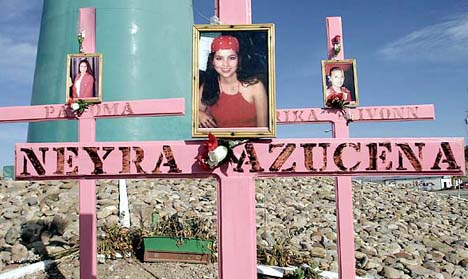
Marisela Escobedo’s life changed forever in August 2008 when her 16-year-old daughter Rubi failed to come home. What was left of Rubi’s body was found months later in a dump -- 39 pieces of charred bone.

Source
Rubi became one more macabre statistic in Ciudad Juarez’s nearly two-decade history of femicide. The murder of young women, often raped and tortured, brought international infamy to the city long before it became the epicenter of the Calderon drug war and took on the added title of murder capital of the world.

But Rubi never became a statistic for her mother. Marisela knew that a former boyfriend, Sergio Barraza, had murdered her daughter. As authorities showed no interest in investigating the case, she began a one-woman crusade across two states to bring the murderer to justice. The Mexican magazine Proceso recently obtained the file on her case. Marisela’s odyssey tracks a murderer, but it also tracks a system of sexism, corruption, and impunity.

It’s an odyssey that ends with Marisela--the mother--getting her brains blown out on December 16, 2010 as she continued to protest the lack of justice in her daughter’s murder two years earlier.

Trail of Impunity

Marisela Escobedo eventually tracked down Barraza. She had him arrested and brought to trial, and finally saw a chance for the hard-sought justice that could at least allow her to move on with her life.

Source
But in Ciudad Juarez, the term “justice” is a bad joke, especially if you’re a woman. Despite the fact that Barraza confessed at the trial and led authorities to the body, three Chihuahua state judges released him. Marisela watched as the confessed assassin of her daughter left the courtroom absolved of all charges due to “lack of evidence.”

As pressure from women’s and human rights organizations mounted, a new trial was called and Barraza was condemned to 50 years in prison. But by that time, he was long gone and still has not been apprehended, despite Marisela’s success in discovering his whereabouts and providing key information to police and prosecutors.

The story doesn’t end there. Every day, Marisela fought for justice for her daughter and sought out the killer. She received multiple death threats. She responded saying, “If they’re going to kill me, they should do it right in front of the government building so they feel ashamed.”

And they did. Marisela took her demands for justice from the border to the state capital where a hit man approached her in broad daylight, chased her down, then shot her in the head.

A family’s story had come full circle. By all accounts, Rubi’s death came at the hands of an abusive boyfriend. Marisela’s death, however, was caused by an abusive system that sought to protect itself from her determination to expose its injustice. The gunman's identity is unknown, but responsibility clearly lies with members of a state at best incapable of defending women and at worst culpable of complicity in killing them.

Gender Violence and Drug Violence


Ciudad Juarez in recent years has been described as a no-man’s Land, where legal institutions have lost control to the armed force of drug cartels. The femicides show us, though, that the causal chain is really the reverse.
Seventeen years ago, Ciudad Juarez began to register an alarming number of cases of women tortured, murdered, or disappeared. Over the decades, national and international feminist organizations pressed the government for justice. The government in turn formed commissions that changed directors and initials with each new governor. They all shared one distinct feature: never getting anywhere on solving the crimes of gender violence, much less preventing them. Recommendations to the Mexican government piled up alongside the bodies: missions from the United Nations and the Organization of American States provided over 200 recommendations on protecting women’s rights, with fifty for Ciudad Juarez alone.

Marisela’s murder marked a year since the Inter-American Court of Human Rights issued a ruling calling the Mexican government negligent in the murders of young women. The ruling on the “Cotton Field” case--named after the lot where the bodies of three women were found on Nov. 21, 2001-- includes a list of measures and reparations, most of which have been rejected or ignored.

Tuesday, November 30, 2010

TEN THINGS MEN CAN DO TO PREVENT GENDER VIOLENCE

Source


  • Approach gender violence as a MEN'S issue involving men of all ages and socioeconomic, racial and ethnic backgrounds. View men not only as perpetrators or possible offenders, but as empowered bystanders who can confront abusive peers. 

  • If  a brother, friend, classmate, or teammate is abusing his female partner -- or is disrespectful or abusive to girls and women in general -- don't look the other way. If you feel comfortable doing so, try to talk to him about it. Urge him to seek help. Or if you don't know what to do, consult a friend, a parent, a professor, or a counselor. DON'T REMAIN SILENT.

  • Have the courage to look inward. Question your own attitudes. Don't be defensive when something you do or say ends up hurting someone else. Try hard to understand how your own attitudes and actions might inadvertently perpetuate sexism and violence, and work toward changing them.

  • If you suspect that a woman close to you is being abused or has been sexually assaulted, gently ask if you can help.

  • If you are emotionally, psychologically, physically, or sexually abusive to women, or have been in the past, seek professional help NOW.

  • Be an ally to women who are working to end all forms of gender violence. Support the work of campus-based women's centers. Attend "Take Back the Night" rallies and other public events. Raise money for community-based rape crisis centers and battered women's shelters. If you belong to a team or fraternity, or another student group, organize a fundraiser.

  • Recognize and speak out against homophobia and gay-bashing. Discrimination and violence against lesbians and gays are wrong in and of themselves. This abuse also has direct links to sexism (eg. the sexual orientation of men who speak out against sexism is often questioned, a conscious or unconscious strategy intended to silence them. This is a key reason few men do so).

  • Attend programs, take courses, watch films, and read articles and books about multicultural masculinities, gender inequality, and the root causes of gender violence.  Educate yourself and others about how larger social forces affect the conflicts between individual men and women.

  • Don't fund sexism. Refuse to purchase any magazine, rent any video, subscribe to any Web site, or buy any music that portrays girls or women in a sexually degrading or abusive manner. Protest sexism in the media.

  • Mentor and teach young boys about how to be men in ways that don't involve degrading or abusing girls and women. Volunteer to work with gender violence prevention programs, including anti-sexist men's programs. Lead by example.


Copyright 1999, Jackson Katz. www.jacksonkatz.com
Reprint freely with credit.


Monday, January 11, 2010

In This Skin: A Reclamation


I have a story to tell, silently and without words: 
'Tis a map laid bare
past drapes of fabric
and layers of armour
and bandages.
Can I trust you
to see past the curves and twists and turns,
the zigzags and crisscrosses invisible
but defining?
Beneath both smooth, unblemished surface
and raised, jagged scar tissue,
dark shadows and fiery bursts of colours mark my skin.
Tattooes etched by
nameless and faceless
artists' hands bring into being
what I cannot say:
This imperfect body is far from beautiful,
but there can be beauty in ugliness
so long as you listen to the story it has to tell.


I am a survivor.


Wednesday, December 9, 2009

Thief of the Night


Words splashed across the page
Boldly erratic and red in its rage
Barely contained
Dignity unretained

Miles away, her screams were heard loud and clear
Echoing forgotten ones of someone dear
Who shut her eyes to draw a clean slate
But soon realized redemption would come a moment too late 

Misty sheets of rain, the turned knob would pour
Yet somehow they remained, the scars that they bore
Seemingly and infinitely unclean
All because of ghost hands that are now unseen

Cover and cower; the silence is now deafening
Run and hide, 'til in their minds their eyes stop smoldering
Soon the skies will lighten, a new day comes without thunder
But two lives have still been torn asunder 


Wednesday, November 25, 2009

Because November 25th is the International Day for the Elimination of Violence Against Women


“Rape’s not something where you just go, “Well, get over it” or “Believe in love and peace, my child, and it’ll all be over.” Well, fuck you, that isn’t the answer. It’s a great thought, OK, but you can go and stick crystals up your butt and get on with it. I’m all for love and peace, but that’s not the side I work on. If somebody would talk about it, or worse, joke about it, I would be ready to kill. That’s not healing. It was a very long time after that before I was able to be with anyone again. And it has never been the same as it was before” 


“Something comes up like bubbles to the surface, bringing up another part of ourselves that has been silent; that we were in the dark about. Lurking. Nightmares aren’t my favorite thing. I want to feel safe, period. My soul wants to feel safe not terrorized.”


“For many years, I shut down that place inside myself that needed to rage, cry, ask questions and basically just express herself. I made a conscious choice when I put ‘Me and a Gun’ on the record not to stay a victim anymore.”


“The last thing I want to be known as is ‘The Girl Who Got Raped’. The big turn around you make in your head is from victim to survivor.”


“You can’t change what happened. And nobody’s asking you to forgive. But you can’t associate all men with violence.”


“It’s about realizing, painfully, you’ve kept that voice inside yourself, locked away from even yourself. And you step back and see that your jailer has changed faces. You realize you’ve become your own jailer.”


“A lot of times you shut off your whole heart off from your experience — you close the door, and you wither and die. My hope is that the RAINN hotline can be a bridge to the next step.” 


“I’m doing this so that people who feel at 21 their lives are over, or they don’t know how to have an intimate relationship, that they can be beautiful again.”


“The idea is to rescue myself from the role of a victim. That I have a choice left. Though I can’t change what has happened, I can choose how to react. And I don’t want to spend the rest of my life being bitter and locked up.”


“People out there must be told about the self-loathing that follows rape and how it’s the greatest breakage in divine law to mutilate themselves, as I have done."


“You decide whether you look at your reality or live pretending these feelings don’t exist.”


“You have to crawl into the wounds to discover what your fears are. Once the bleeding starts, the cleansing can begin.”


“I started to accept the mess I’m in. I know that mess spelled backwards is ssem and I felt much better armed with that information.”


“I think you have to know who you are, get to know the monster that lives in your soul, dive deep into your soul and explore it.”


“I see the dream and I see the nightmare, and I believe you can’t have the dream without the nightmare.” 


“I think that the nightmares are telling me things about myself that I need to know. And I try to understand what they mean, so I can get to know something more about my soul.”


“Anger is healthy, but out of balance if it doesn’t have compassion.”


“I am finding that vulnerability gives me great strength, because you’re not hiding anymore.” 

Tuesday, November 24, 2009

1 in 3 is More than a Statistic to AmerIndian Women


Leslie Ironroad was 20 years old when she moved from one side of the Standing Rock Sioux Reservation in the Dakotas to the other — the town of McLaughlin, S.D., home to one gas station, one diner and her friend, Rhea Archambault. She roomed in Archambault's spare bedroom.
"I make star quilts, so she was helping me make patterns," Archambault said recently, sitting at her dining room table. "She was just a nice little girl."
One night four years ago, Ironroad left the house to go to a party a few miles away. Early the next morning, she called Archambault's brother in tears asking to be picked up.
"She said, 'Can [you] go get Rhea to come get me 'cause these guys are going to fight me,'" Archambault said. "And so he said, 'Well where you at?' And she was just crying and hangs up."
Leslie never made it home.
When Archambault found her friend in a Bismarck, N.D. hospital, she was black and blue.
"'I said, 'Leslie, what happened?.' She said, 'Rhea, is that you? Turn the lights on, I can't see.' But the lights in the room were on. She said, 'Rhea, I was raped,' and she was just squeezing my hand," Archambault recalled.
Archambault called the Bureau of Indian Affairs police, a small department in charge of all law enforcement on the reservation. A few days later an officer arrived in the hospital room, and Leslie scratched out a statement on a tablet laid across her stomach.
Ironroad told the officer how she was raped and said that the men locked her in a bathroom, where she swallowed diabetes pills she found in the cabinet, hoping that if she was unconscious the men would leave her alone. The next morning, someone found her on the bathroom floor and called an ambulance.
A week later, Ironroad was dead — and so was the investigation. None of the authorities who could have investigated what happened to Leslie Ironroad did — not the Bureau of Indian Affairs, nor the FBI, nor anybody else.
People who know the men who likely attacked her say they were never even questioned.
Archambault couldn't believe nothing came of Ironroad's report.
"She named all the people that were there, the ones that were hitting her, the ones that were fighting her, she named everybody — what more else?" Archambault asked.
Unreported, Uninvestigated and Unprosecuted


We must never permit the voice of humanity
within us to be silenced. It is Man's sympathy with all creatures that first makes him a Man.

--Albert Schweitzer

Everything can be taken from a man or a woman but one thing: the last of human freedoms to choose one's attitude in any given set of circumstances, to choose one's own way.


--Viktor E. Frankl