Showing posts with label news. Show all posts

Wednesday, April 20, 2011

An Inheritance of Anger: The Oppressed Becomes the Oppressor

Turkey: Kurdish Youth Losing Faith in Peaceful Protests 


Sunday, January 23, 2011

The Murdered Women of Juarez

The Murdered Women of Juarez

by Laura Carlsen
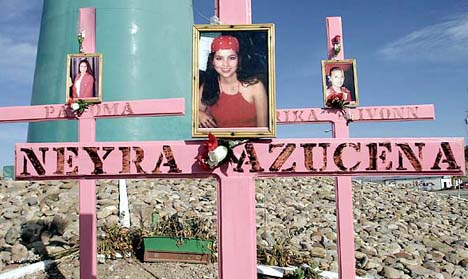
Marisela Escobedo’s life changed forever in August 2008 when her 16-year-old daughter Rubi failed to come home. What was left of Rubi’s body was found months later in a dump -- 39 pieces of charred bone.

Source
Rubi became one more macabre statistic in Ciudad Juarez’s nearly two-decade history of femicide. The murder of young women, often raped and tortured, brought international infamy to the city long before it became the epicenter of the Calderon drug war and took on the added title of murder capital of the world.

But Rubi never became a statistic for her mother. Marisela knew that a former boyfriend, Sergio Barraza, had murdered her daughter. As authorities showed no interest in investigating the case, she began a one-woman crusade across two states to bring the murderer to justice. The Mexican magazine Proceso recently obtained the file on her case. Marisela’s odyssey tracks a murderer, but it also tracks a system of sexism, corruption, and impunity.

It’s an odyssey that ends with Marisela--the mother--getting her brains blown out on December 16, 2010 as she continued to protest the lack of justice in her daughter’s murder two years earlier.

Trail of Impunity

Marisela Escobedo eventually tracked down Barraza. She had him arrested and brought to trial, and finally saw a chance for the hard-sought justice that could at least allow her to move on with her life.

Source
But in Ciudad Juarez, the term “justice” is a bad joke, especially if you’re a woman. Despite the fact that Barraza confessed at the trial and led authorities to the body, three Chihuahua state judges released him. Marisela watched as the confessed assassin of her daughter left the courtroom absolved of all charges due to “lack of evidence.”

As pressure from women’s and human rights organizations mounted, a new trial was called and Barraza was condemned to 50 years in prison. But by that time, he was long gone and still has not been apprehended, despite Marisela’s success in discovering his whereabouts and providing key information to police and prosecutors.

The story doesn’t end there. Every day, Marisela fought for justice for her daughter and sought out the killer. She received multiple death threats. She responded saying, “If they’re going to kill me, they should do it right in front of the government building so they feel ashamed.”

And they did. Marisela took her demands for justice from the border to the state capital where a hit man approached her in broad daylight, chased her down, then shot her in the head.

A family’s story had come full circle. By all accounts, Rubi’s death came at the hands of an abusive boyfriend. Marisela’s death, however, was caused by an abusive system that sought to protect itself from her determination to expose its injustice. The gunman's identity is unknown, but responsibility clearly lies with members of a state at best incapable of defending women and at worst culpable of complicity in killing them.

Gender Violence and Drug Violence


Ciudad Juarez in recent years has been described as a no-man’s Land, where legal institutions have lost control to the armed force of drug cartels. The femicides show us, though, that the causal chain is really the reverse.
Seventeen years ago, Ciudad Juarez began to register an alarming number of cases of women tortured, murdered, or disappeared. Over the decades, national and international feminist organizations pressed the government for justice. The government in turn formed commissions that changed directors and initials with each new governor. They all shared one distinct feature: never getting anywhere on solving the crimes of gender violence, much less preventing them. Recommendations to the Mexican government piled up alongside the bodies: missions from the United Nations and the Organization of American States provided over 200 recommendations on protecting women’s rights, with fifty for Ciudad Juarez alone.

Marisela’s murder marked a year since the Inter-American Court of Human Rights issued a ruling calling the Mexican government negligent in the murders of young women. The ruling on the “Cotton Field” case--named after the lot where the bodies of three women were found on Nov. 21, 2001-- includes a list of measures and reparations, most of which have been rejected or ignored.


Tuesday, September 21, 2010

A Step in the Right Direction


Philippines weighs charges over hostage standoff

MANILA, Philippines – President Benigno Aquino III said Manila's mayor, a recently retired police chief and journalists were among a dozen people who could be charged over last month's disastrous hostage standoff that killed eight Hong Kong tourists and damaged ties with China.
Source
The recommended charges, both criminal and administrative, were part of a government investigation report on the Aug. 23 hostage crisis that has been handed over to the Chinese ambassador. 
Aquino said Monday he will decide whether to approve the filing of charges, including against one of his close aides, after government lawyers have studied the lengthy report and he has returned from an upcoming U.S. trip.
The president told a nationally televised news conference that his administration wanted to speedily render justice to the victims and help the survivors "get back to their lives."
"We are repairing relations with (China)," Aquino said.
The 11-hour hostage standoff and bungled rescue attempt on a bus parked at a historic Manila park — which millions watched on live TV — strained ties with China and its territory of Hong Kong. Both warned against travel to the Philippines, and thousands of tourists canceled bookings.
The crisis was Aquino's first major test, coming less than two months into his presidency, and highlighted problems within the underfunded police force and his new Cabinet.
Scrambling to handle the fallout, Aquino created a fact-finding committee led by Justice Secretary Leila deLima, who submitted an 83-page investigation report on Friday.
The report cited at least eight major blunders by authorities, including then Manila police chief Rodolfo Magtibay's alleged refusal to heed the president's order to deploy an elite police commando unit instead of a local SWAT team and his decision to leave the hostage scene with the Manila mayor for a nearby restaurant shortly before the carnage erupted.
Magtibay was replaced while the rescue was under way.
The bungled rescue "was the convergence of efficiencies omitted and inefficiencies committed throughout the day," the report said.

Sunday, September 19, 2010

Suicide in Harvard Yard

Yesterday morning, one of my friends passed through the Yard on his way to the Science Center when he heard what sounded like "a pop of fireworks" go off behind him.  He was in a hurry, so he didn't turn back to see what was going on. "I thought some kids were goofing off," he wrote to me. When he came back from the Science Center, he found parts of the Yard cordoned off by police tape. The "pop of fireworks" he heard earlier? Well, it was a man who shot himself in the head in front of a tour group.  Boston Globe reports: 


Harvard University Police Department received a call around 11 a.m. reporting the shooting outside Memorial Church, according to Harvard spokesman John Longbrake.
Police arrived to discover the body of a man with a self-inflicted gunshot wound to the head, Longbrake said.
It appeared that he was not affiliated with Harvard, Longbrake said.
The suicide occurred during a Yom Kippur service, which was being held by a Reform minyan, a student-run Jewish community at Harvard.


Source
I'm no stranger to suicide. I've lost someone I dearly love, as well as a couple other friends, to suicide. It's not a "victimless crime" as others like to say; it leaves a long line of victims in its wake.  A lot of people might disagree with me on this, but I believe that those who commit suicide are neither cowards nor selfish--it's not for me to judge those who commit suicide, because only they know the depth and circumstances that led them to believe that there is no other relief, solution, or escape.

That being said, I do wonder why he chose to end his life in Harvard Yard. What's the significance? Did he feel so invisible, voiceless, and inconsequential that he thought the only way for him to be seen and heard is to attach the violent end of his life to a well-known institution? I know that most people self-harm to make tangible the pain they feel inside, so was it his way of trying to make people see just how much pain he was in?

I do not know this man who committed suicide, but I do know he deserves peace. I hope that he's found relief wherever he is.

Wednesday, September 1, 2010

A dying patient is not a battlefield


By Theresa Brown, Special to CNN
August 31, 2010 10:30 a.m. EDT

Source


Editor's note: Theresa Brown is an oncology nurse in Pennsylvania. She is a leading contributor to The New York Times' blog Well. She is the author of "Critical Care: A New Nurse Faces Death, Life, and Everything in Between."
(CNN) -- The patient, in his late 70s, had survived prostate cancer and had a new diagnosis of leukemia. A few days before, he'd been healthy and fine, but now his white blood cell count was so high that it was clogging his circulatory system, making it hard for him to breathe.
We brought his white count down and relieved his shortness of breath. At that point, he could have opted for palliative care and gone home on hospice with a decent enough quality of life to enjoy what little time he had left. However, the patient, encouraged by his family and urged on by his oncologist, chose aggressive treatment instead.
This is a hard case. In his recent New Yorker article "Letting Go," Dr. Atul Gawande explains how the first impulse of doctors, patients and family members to "fight" cancer or other serious illnesses makes it very difficult to have honest discussions of what treatment can and cannot do.
I understand why physicians find these conversations difficult, why it's preferable to focus on the good we can possibly accomplish rather than the likely futility of the struggle.
But there's another story to be told in these cases, and it's usually the nurse who's the observer of that narrative: the suffering caused by these well-intentioned treatments. Chemo was risky for this patient because of his age and medical history, and the damage done was unbelievably bad.
The problems began when cells killed by the chemotherapy spilled their contents, overloading my patient's kidneys and throwing him into renal failure. The intravenous fluids he'd needed had been too much for his circulatory system, and he developed heart failure, too.
Watching this patient suffer ... because of what we did to him in the name of helping him was agonizing.
--Theresa Brown
One morning, I came in with his pills, and he said, "You're doing too much. I can't take it." The next week, he was on dialysis, but it wasn't working, and his entire lower body was hugely swollen with fluid. That day, he accosted me with, "What the hell are you doing to me?"
Both times, I told the medical team what he'd said and asked whether it was ethical to continue chemotherapy. Several members of the team shared my concerns, and as a group, we talked the situation over with the attending doctor. Our view was that the treatments were eroding the patient's quality of life with little promise of good in return.
The attending physician, whom I know to be conscientious and caring, disagreed, as did the patient's family. When the doctor prodded the patient, saying, "You want to keep going, right? Right?" the patient himself concurred, "Yes, let's keep going."
So the chemo finished. Then, blood began to appear in the patient's urine. His bladder was brittle because of the radiation treatments he'd had for prostate cancer, and because of the chemo, he had too few platelets. Without enough platelets, that fragile tissue would not stop bleeding, but it also formed blood clots in his bladder that caused excruciating pain.
Watching this patient suffer, not from his disease but because of what we did to him in the name of helping him, was agonizing. He'd wanted to "keep going," to "keep on fighting," but what did he really mean?
Always when I hear these phrases applied to oncology patients, I think of Peter Weir's 1981 film "Gallipoli." The film portrays two Australian sprinters, Archy and Frank, who enlist together during World War I and end up fighting the Turkish army at the Battle of Gallipoli.
A lot of soldiers died during the Gallipoli campaign, and the end of the film dramatizes a real battle in which four brigades of Australian soldiers were sent out of the trenches to certain death.
Frank is chosen to be a runner, a deliverer of messages during the battle, and he gets an order to call off the assault once it's clear that it's not a fight but a massacre. However, Frank can't run quickly enough to get the hold order to Archy's trench in time, and the signal to attack is given. Archy comes up out of the trench running as fast as he can, alone, chest forward, until the Turkish machine guns mow him down.
The wasteful sacrifices of war and the pointlessness of my patient's suffering share some obvious parallels here, but there's a deeper lesson as well. Archy and Frank were soldiers; my patient was not. They made a choice when they enlisted, but my patient was never given his real choice, between aggressive treatment that might do more harm than good and getting just enough treatment to keep him stable and allow him to go home to be with the people he loved.
The very real benefits of such a focus on palliative care were documented in the August 19 issue of the New England Journal of Medicine. Patients with newly diagnosed lung cancer who received palliative care in addition to chemotherapy claimed an improved quality of life and lived more than 2½ months longer than than those who had no such care.
My patient's decision to "keep fighting" seemed to be based on a misperception of what medicine could accomplish and of what the personal costs of our treatments would be. Indeed, a month after being admitted, swollen, breathless, bleeding and in pain, with his leukemia as robust as ever, he went on hospice in the hospital and died.
In "Letting Go," Gawande says we don't want Gen. George Custer as a model in medicine but more Robert E. Lee. But I would argue that conjuring a general to guide patients faced with serious illness is an embrace of the wrong ideal. Patients are not battlegrounds, and practicing medicine is not a war. This patient needed thoughtful supportive care, not our ineffectual treatments that tore him up from the inside out as surely as any machine gun.
The opinions expressed in this commentary are solely those of Theresa Brown.

Friday, August 27, 2010

Micro-loans Available Through Cherokee Nation Program

Cherokee Nation News Release
(918) 453-5378 FAX (918) 458-6181
Cherokee Nation Director of Communications@cherokee.org
© Cherokee Nation - All Rights Reserved


Source
Sometimes a small boost is all that’s needed to get a business underway or to help get credit on the right track. That’s the premise behind some of the small business loan programs available now through the Cherokee Nation.

The tribe’s Small Business Assistance Center, located at 17675 S. Muskogee Ave., in Room 105, is now taking applications for micro-loans to help start up a new small business or to improve an existing one, by adding new materials, work tools or merchandise. Credit-builder loans start with amounts as small as $100 and are geared towards artists and home-based businesses. Other types of micro-loans are available as well.

Small business owners or would-be entrepreneurs can get the ball rolling by meeting with one of the SBAC’s business coaches. The borrower must work with the coach to develop a business plan and will be required to attend a business planning workshop before the loan is submitted for approval.

Interested parties may also simply attend an informational workshop hosted by the SBAC to see whether a micro-loan is right for their business. Dates and locations for upcoming workshops include:

     Collinsville— Monday, Aug. 30, from 11 a.m. to 1 p.m. at 1323 W. Broadway St. 

     Kansas, Okla.—Wednesday, Sept. 1, from 6 p.m. to 8 p.m. at the Northeast Technology    Center, 450 N. Highway 59 

     Bartlesville— Friday, Sept. 3 from 1 p.m. to 3 p.m. at 1003 S. Virginia Ave.

To participate in the micro-loan programs, applicants must be a citizen of a federally recognized tribe and must live within the Cherokee Nation’s 14-county jurisdictional area. Other eligibility criteria may apply, depending on the specific program.

For more information please contact Veronica Hix at (918) 207-3955 or e-mail 
veronica-hix@cherokee.org.


Tuesday, August 24, 2010

Philippine police: Authorities botched hostage rescue


By the CNN Wire Staff
August 24, 2010 9:25 a.m. EDT


Manila, Philippines (CNN) -- Authorities botched rescue efforts during a deadly hostage situation on a tourist bus, the Philippine National Police said in a statement Tuesday.
Manila police said former police officer Rolando Mendoza, upset at having lost his job, held hostage a busload of tourists from Hong Kong on Monday and killed eight of them before being shot dead.
"We do not want to pass sweeping judgment or make early conclusions except to say that our intention to peacefully end this hostage drama was spoiled when the hostage-taker suddenly exhibited violent behavior and began shooting the hostages," Philippine National Police Chief Director General Jesus A. Verzosa said in a statement.
But a statement from the national police said officials have already noted "some observations and defects during their close monitoring of the unfolding events."
Video: Surviving the Manila bus standoff
Video: Hong Kong issues Philippine warning
Video: Hostage aftermath in Philippines
Video: Bus hostage drama ends in Philippines
The statement did not provide details, but lists "poor handling of the hostage negotiation," "inadequate capability, skills, equipment and planning of the assault team," "improper crowd control," "inadequate training and competence of assault team leader" and "non-compliance to media relations procedures in hostage situations."
Police said Tuesday that the bus had a television on board, which could have allowed the gunman to watch live coverage of the standoff.
Survivors were scheduled to leave the Philippines Tuesday as officials and family members called on authorities to investigate.
"The investigation has got to find out, what was the turning point? What happened?" Philippine National Red Cross Chairman Richard Gordon told CNN Tuesday.
Gordon told CNN that interviews with survivors have revealed that the situation inside the bus changed dramatically toward the end of the 10-hour standoff.
"Apparently the man went berserk. He was telling everybody he was not going to harm [them]...He said that nobody's going to get harmed. He said that he was probably going to die, but not the hostages," he said.
A woman who was on the bus told reporters her husband was killed when he tried to stop the gunman.
"My husband was very brave. He rushed out from the back of the bus to try to stop the killer," said the woman, who identified herself as Alicia Leung.
She told reporters that she pretended to be dead in order to survive.
"Why did authorities not rescue us? There were so many of us on the bus. Why did no one come to rescue us? It is so cruel," she said.
In Manila, Philippine President Benigno Aquino III said he had ordered an investigation, and would wait until it is completed before deciding whether anyone should lose his or her job.
In Hong Kong, officials and residents questioned how Filipino authorities had handled the hostage situation.
"This is a serious blow to Hong Kong people. We all feel very devastated," Hong Kong Chief Executive Donald Tsang told reporters Tuesday, saying that the government would soon announce community mourning events.
Four men and four women were killed in the standoff, authorities in Hong Kong said. One passenger was critically wounded and six others were hospitalized with less serious injuries after the 10-hour standoff erupted into gunfire, Tsang said.
The Hong Kong-based tour guide was among those who died, Hong Thai Travel said in a statement. Some of the victims were insured and would be compensated, the travel agency said.
The gunman released nine of the hostages, including a mother and her three children, a man with diabetes, and two photographers. The bus driver also escaped.
The British Foreign and Commonwealth Office said Tuesday that two of the released hostages were British nationals.
Manila police official Leocadio Santiago told CNN that Mendoza's family members spoke with him early in the standoff and that he appeared "very reasonable and very psychologically stable."
Mendoza was dismissed a year ago for extortion, Manila Vice Mayor Ikso Moreno said, and he wanted his motion for reconsideration to be heard.
"He felt that it was being neglected," Moreno said. "So he went on hostaging a bus full of foreign individuals. So when we talked to him this afternoon, that's what he wanted."
Moreno said that Mendoza's brother was arrested because he was "guilty of conspiring with his brother" and allegedly helped instigate the shooting.
Gordon said the brother's arrest may have pushed the gunman over the edge.
"When he saw his brother getting accosted by the policemen, he went berserk and he started firing," he said.
CNN's Sarita Harilela and journalists Constance Cheng, Maria Ressa and Arlene Samson-Espiritu contributed to this report.

We must never permit the voice of humanity
within us to be silenced. It is Man's sympathy with all creatures that first makes him a Man.

--Albert Schweitzer

Everything can be taken from a man or a woman but one thing: the last of human freedoms to choose one's attitude in any given set of circumstances, to choose one's own way.


--Viktor E. Frankl