Showing posts with label Americans. Show all posts

Thursday, September 29, 2011

30 Day Challenge, Day 2: The meaning behind your blogger name

the UNchecked other refers to both my being hapa and ethnicity/race identification government forms.  In some forms, there is a box called other in lieu of multiracial/multiethnic or mixed. It may sound silly to some and maybe something only fellow hapas can truly understand, but I've always rebelled against the checking of any of these neat little boxes. Most of the time I write hapa or mixed, but sometimes I simply write in HUMAN.


To be hapa is to live in the borderlands, and to exist in these amalgam lands means that I refuse to check one box in those optional race questions on forms. To choose one race over the other would be to negate the other parts that make me, me. If I check other, it would imply that hapa people such as myself have no place that warrants being named. In my cultures—Native or otherwise—not having a name means that you neither exist nor matter. Unseen and unheard, you are a ghost, stripped of the dignity of what it is to be human.

Conversely, I refuse to say I am a quarter this, half that, or part these. Hapa identity is a whole identity that is made from whole ethnicities, races, cultures, traditions, and people. I refuse to be divided into neat little fractions. My ancestry comes as a whole and manifests its influence over me in a uniquely all-encompassing hapa way.

With my held held high, I choose to be the UNchecked other.


Source


Friday, March 4, 2011

Home (I No Longer Recognize)

***NB: This post was originally an E-mail I wrote to one of my friends after going back home and finding myself a stranger. Despite the melancholic, frustrated, and defeatist tone in the E-mail, I have now thankfully come to a sense of peace...and empowerment. Yes, hope may fade fast, but it can never truly be gone so long as the last person who gives a damn about changing the status quo still stands.

Source

The Hawai'i I left behind was a paradise. In my memory, at least. It was one of innocence and joy, despite it being where my da died. How naive. Everything is so different now. Or is it that I was blind before and now my eyes are wide open? Were some people I used to know always that concerned about image and class distinction? Has my friend [redacted] always believed that all Muslims are terrorists or terrorists-in-training? Is it an exaggeration to feel upset when I see my Hawaiians--people who look like me--serve me at the country club, where most of the members are White? Is it weird to feel a lump in my throat to see my Native people languishing in poverty while the people with whom I (used to) belong are driving around in expensive cars or have haircuts that are the equivalent of a whole week's paycheck for minimum wage workers? Is it foolish to care so much about the pain of others, their hardships, and the injustices they've experienced? Is it better to be selfish, avert my eyes, and stand up only for my own well-being? Is it possible to turn off the compassion in your heart when it is so much a part of you?

Source
My Hawai'i may be a salad, but it certainly has its rotten parts. The income disparity is so jarring. In Kahala, houses cost millions of dollars and have climate-controlled pools, manicured lawns, and winding driveways. On the other side of the island, broken pavements and ramshackle houses crookedly line the horizon.  This is the other side of my island paradise, past the plastic glamour of Waikiki and beyond Maui's exclusive gold courses. It's an all-too-real Hawai'i, where impoverished  men take out their anger on the haoles--they who stole Hawaiian lands--by beating their wives and children or resorting to an all-too-common escape--drugs and alcohol. The cycle continues. Sometimes this anger and violence become an inheritance of sorts, a tradition passed down through the generations like a quilt your tutu made lovingly. I see it in the rage of unemployed men who feel emasculated by a society that judges masculinity in proportion to bank account balances. I feel it in their wives' resignation to their fate. I hear it in their children's silent shame. A similar truth is screamed at AmerIndian reservations, Pinoy shanties, or Brazilian favelas. Perhaps it's not one culture's or one people's truth: it is a universal truth, one that the world dares not speak of, but inwardly scream. It is our collective cross to bear. 

Luv, my Hawaiians and my AmerIndians are on the verge of becoming caricatures. Some are forced to sell out and exoticize our culture for money. Some of my brothers and sisters dress up in our ancestral garb, then dance and perform for tourists. Sometimes it is not the truth of our culture or traditions that they share.  Grass shirts have become cheap, dyed straw skirts and hula chants have given way to the easily understood "Tiny Bubbles." Of course, tourists don't know differently. And because of this economic crises, my people allow these tourists to keep believing this image. Lies become truths as long as the money flows.

I do not judge my  people for doing what they have to do in order to survive. Nor do I pity them--not really--because that would imply that I am better than them, which I am not. What I feel is a loss. Loss and loneliness. And fear. I fear that perhaps one day, my cultures and traditions will be lost. 

And with it, our pride as a people who have already endured so much. 


Thursday, November 25, 2010

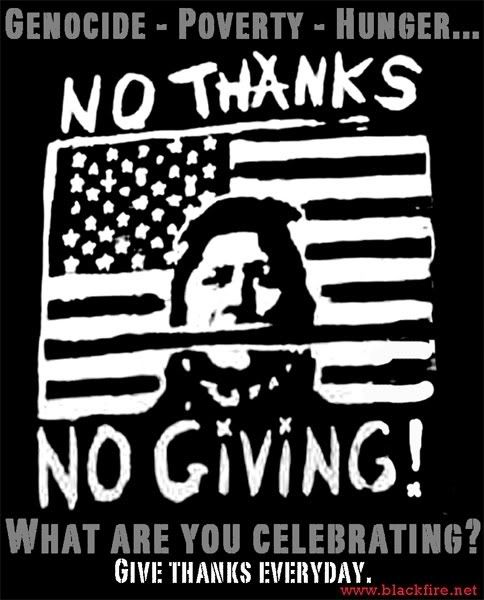
The True Story Of Thanksgiving

Originally written by Richard Greener for The Huffington Post.


Richard Greener

Richard Greener

Posted: November 25, 2010 10:04 AM


The idea of the American Thanksgiving feast is a fairly recent fiction. The idyllic partnership of 17th Century European Pilgrims and New England Indians sharing a celebratory meal appears to be less than 120 years-old. And it was only after the First World War that a version of such a Puritan-Indian partnership took hold in elementary schools across the American landscape. We can thank the invention of textbooks and their mass purchase by public schools for embedding this "Thanksgiving" image in our modern minds. It was, of course, a complete invention, a cleverly created slice of cultural propaganda, just another in a long line of inspired nationalistic myths.
The first Thanksgiving Day did occur in the year 1637, but it was nothing like our Thanksgiving today. On that day the Massachusetts Colony Governor, John Winthrop, proclaimed such a "Thanksgiving" to celebrate the safe return of a band of heavily armed hunters, all colonial volunteers. They had just returned from their journey to what is now Mystic, Connecticut where they massacred 700 Pequot Indians. Seven hundred Indians - men, women and children - all murdered.
Source
This day is still remembered today, 373 years later. No, it's been long forgotten by white people, by European Christians. But it is still fresh in the mind of many Indians. A group calling themselves the United American Indians of New England meet each year at Plymouth Rock on Cole's Hill for what they say is a Day of Mourning. They gather at the feet of a stature of Chief Massasoit of the Wampanoag to remember the long gone Pequot. They do not call it Thanksgiving. There is no football game afterward. 
How then did our modern, festive Thanksgiving come to be? It began with the greatest of misunderstandings, a true clash of cultural values and fundamental principles. What are we thankful for if not - being here, living on this land, surviving and prospering? But in our thankfulness might we have overlooked something? Look what happened to the original residents who lived in the area of New York we have come to call Brooklyn. A group of them called Canarsees obligingly, perhaps even eagerly, accepted various pieces of pretty colored junk from the Dutchman Peter Minuet in 1626. These trinkets have long since been estimated to be worth no more than 60 Dutch guilders at the time - $24 dollars in modern American money. In exchange, the Canarsees "gave" Peter Minuet the island of Manhattan. What did they care? They were living in Brooklyn.
Of course, all things - especially commercial transactions - need to be viewed in perspective. The nearly two-dozen tribes of Native Americans living in the New York area in those days had a distinctly non-European concept of territorial rights. They were strangers to the idea of "real property." It was common for one tribe to grant permission to another to hunt and fish nearby themselves on a regular basis. Fences, real and imagined, were not a part of their culture. Naturally, it was polite to ask before setting up operations too close to where others lived, but refusal in matters of this sort was considered rude. As a sign of gratitude, small trinkets were usually offered by the tribe seeking temporary admission and cheerfully accepted by those already there. It was clearly understood to be a sort of short-term rental arrangement. Sad to say, the unfortunate Canarsees apparently had no idea the Dutch meant to settle in. Worse yet for them, it must have been unthinkable that they would also be unwelcome in Manhattan after their deal. One thing we can be sure of. Their equivalent of today's buyer's remorse brought the Canarsees nothing but grief, humiliation and violence.

Dismantling Thanksgiving Myths: A Native American Story


Originally published by NDN News in November 2008, but the topic at hand is a timeless TRUTH of the history of our country. 

Dismantling Thanksgiving Myths: A Native American Story

Source

by Aisha Ali, D.C. Youth Issues Examiner


In less than two weeks, Thanksgiving will arrive. The need for celebration may not come as easily for those who have lost their homes and have suffered many misfortunes throughout the year. However, one should be thankful for just being alive, shouldn’t they?

Nonetheless, I view Thanksgiving differently from others, even before this current economic crisis. While I always have expressed "thanks" for the many blessings God has bestowed upon me, with underserved communities experiencing destitution, living in substandard housing, being unable to properly care for their children; to afford health care; or to just overall survive, how could I be happy? To know many people would be homeless or starving on Thanksgiving certainly does evoke a "warm, light-hearted feeling".

The lives many Americans have experienced within the past few years, especially within the past year, have been the “ordinary” lives of many individuals for quite some time. Yes, the desolate life of others does intensify my gratefulness; however, as is the case with many middle-class Americans, my family has always been two or three paychecks away from homelessness. Still, this suffering of which I think on Thanksgiving does not discriminate me from others, as I am quite certain other Americans share the same sentiment. My view of Thanksgiving differs given my ethnic background as an individual of both African- and Native American descent. It is for this reason I always have held a jaded view concerning Thanksgiving, knowing its true history— or the true Native American story-- has yet to be published in many American history books.

In my eyes, Thanksgiving has never been about the Pilgrims-- and to many Americans, I question if this is their sole source of celebration, as many people blindly celebrate holidays and have no clue of their history. Although I am sure many people celebrate Thanksgiving as a way to express “thanks,” for me, Thanksgiving serves as another remembrance of how my Native American ancestors were maltreated; annihilated; ousted from their land; and consigned to reservations, eradicating every trace of their pre-existing life.

Thanksgiving rehashes memories of how the hospital staff, in its refusal to treat my great-great grandfather, sent him home to die from pneumonia because he was Native American. Thanksgiving reminds me of how my great-grandmother had “to pass” as a light-skinned black person to avoid being forced on a reservation. When thinking of Thanksgiving, I recall how my Nation, the Cherokees, was forced from its land in Georgia, leaving a “Trail of Tears.” As I sit around with my family and share thoughts while eating on Thanksgiving, I think of how the very ingredients with which my food was prepared, had been once picked by the hands of my Native American ancestors who served as slaves in North Carolina and the Caribbean. Needless to say, I also think of my African ancestors who toiled away in the fields to pick the very foods with which my food was prepared. America, to me, is not the “Land of Pilgrim’s pride," but should be and is to me, the "Land of Native American pride".

The national holiday, “Thanksgiving,” was not initially created in the way most Americans have come to know it.

Saturday, September 11, 2010

Quote of the Week


Source


Everything can be taken from a man or a woman but one thing: the last of human freedoms to choose one's attitude in any given set of circumstances, to choose one's own way. 


--Viktor E. Frankl 

Saturday, July 3, 2010

American Anthem in the language of its original Mother


Saturday, December 5, 2009

Quis Custodiet ipsos Custodes?: Why I Speak


My love affair with politics was a pre-ordained destiny chosen for me by well-meaning relatives on my momma's side of the family. It began as their hope--hope for the continuation of a family legacy--which became mine the second they recognized in me an aptitude for words and a so-called commanding presence in public speaking. So they nurtured a potential that was more evident to them than it was to me, and in this nurturing the seed of gradual transference of dreams and passions slowly began to take root. 


Out of all his grandchildren, my grandfather chose me as his successor--the one who would strengthen the political dynasty he wasn't quite finished building when partial paralysis robbed him of his powerful oratory skills. Whenever my parents and I would visit, I'd be summoned by my grandfather to talk. Over drags of cigarettes and sips of coffee, he would talk to me about game theory, political posturing, diplomacy, candidacy...


I was only six years old. 


I thought such grandfather-granddaughter dynamic was normal, until the day I realized that with my other cousins, he discussed the importance of obedience to one's elders and which countries produced superior chocolates. Whenever he asked them about school, it was always in the framework of whether or not they made new friends or what they had for lunch, or what they learned. 


So I asked my momma and grandmother why he didn't see me as a child, and in hushed voices, they told me that my marked difference was a privilege. It was an honour for such a learned man to groom me to be his equal. His staggering brilliance and titanic legacy would be passed on to me. Even at a young age, I understood the weight of this inheritance, but to my momma and grandmother, it was a pair of coveted wings; a privilege my grandfather did not deem them worthy of.  


"You are an American," they proudly said, "and you have the chance to fulfill your potential. You can marry a powerful politician and together, you will be stronger. You are lucky." 


And so there it was, laid bare: American privilege. My citizenship was simultaneously a beacon of hope--the triumph of my colonized ancestors--and the invictus sword of elitist masters who colonized. At such a young age, I became keenly aware that I lived in the borderlands. In these amalgam lands, I began to understand the importance of examining the little details that people overlook, and to listen to every story regardless of how many times I heard similar ones. 


They didn't count on my American-ness to be flawed. My constitutionally-protected American freedom of expression gives me the luxury to be able to question the validity of everything and to seek truth far deeper than what is seen by the naked eye. My American outspokenness allows me to speak my mind, regardless of whether or not the world agrees with me. My American sense of human rights advocacy made me value humanity, truth, and justice over political posturing and saving face. My American sense of identity values my ancestors' cultures, languages and traditions--fights for their preservation and revitalization--but refuses to follow blindly to legacies without first exploring the unknown. 


Confession.


My momma's side of the family remains, to this day, Marcos loyalists and apologists. I grew up believing that Macoy and La Imierda were the saintly saviours and heroes of the Philippines. I grew up defending Imierda's vast shoe collection and extravagant parties as small repayments for a great service to the country. Martial Law, as explained by my grandparents, was good. Because of the vigilance of the Marcos administration, the Philippine military, and the Philippine police, criminals were forced to confront the error of their ways and learned to suppress their "evil urges." Those who were defiant were quickly arrested and brought to justice. The Marcos era was a proud, prosperous time in the Philippines, wherein a Third World country held the esteemed audience of the First World nations it wanted to become. 


But that was their truth, not my own.


I found the missing pieces to the story of the Pilipino people years later, long after the dictator perished in shameful exile. I, who have Pilipino blood coursing through my veins, learned about the history of the Pinoys as a high school student in Hawai'i, from Pinoy political refugees. "What do you mean there are Pinoy political refugees? I thought only Vietnamese, Cambodians, Cubans, Eastern Europeans, and Africans were political refugees." I asked the old, one-armed man who lived at the nursing home where I volunteered. And in his hoarse, heavy-accented voice, Manong Isko told me his story. 


He was a priest who dared to speak out for a nun who was brutally raped  and left for dead by several members of the Pilipino military. She was found buried underneath rotted garbage in Smoky Mountain with her  dark blue skirt bunched around her waist and her Rosary beads hanging out of her skirt pockets. Manong Isko wanted me to know that her name was Sr. Maria Cecelia--birth name Clarita--and she was a 30-year-old woman who loved to cook sinigang na hipon and play the bandurria. Sr. Maria Cecelia was a beautiful Spanish mestiza, which was probably why these rapists targeted her, disregarding the fact that this young woman made purity vows to serve God. He was their God, too, supposedly. Yet in times when man shows his darkest shadows, it is difficult to reconcile this duality. Manong Isko--who was Brother Franciso in another life--raged. He went into Camp Crame to file a complaint and refused to leave until they listened; for this insubordination, he was taken into an interrogation room. Details of what happened next, Manong Isko did not want to elaborate to a 14-year-old, but the tears in his eyes and the tremor that shook the stump that used to be his right arm told the whole story. He remains in Camp Crame still.


Quis custodiet ipsos custodes, I ask? Who will guard the guards? 


The Marcos government regime enacted a campaign of terror, abuse, fear, and silence against its own citizens. The rapes, robbery, murders, and terror were not absent; they were just swept away and spoken about in soft whispers and averted eyes. It didn't happen to us, so there's no need to get involved became the collective credo. For the elite bystanders, there was no need to make ripples in the water lest they get drowned in the tsunami of retribution. My family was unharmed and retained our properties and social standing because Marcos was an ally. My family never had to worry about receiving phone calls in the middle of the night, telling us about an unfortunate accident that claimed the life of a beloved. Born into a working-class family, La Imierda and her Macoy sought validation and acceptance from old money alta sociedades, to further assert their righteousness and worth in the international arena of must-haves. In turn, alta sociedades wanted to retain their power, fearful of descending into the dreaded masses. Quid pro quo. Silence and indifference was acquiescence, and for the privilege of being untouchable, the price was humanity. It was the country, as a whole, that paid the price. 


I know now that there are some people who sit in their thrones not because of their power, but because they relinquished it. Power is subjective, and for some, the price of a throne, privilege, or elitism is the abandonment of their freedom and individuality. Power, for some, is worth the price of what it means to be human. 


My activism and outspokenness as a twenty-something is shaped by a six-year-old me who was told I would one day take over my grandfather's legacy. Despite his brilliance and his success, and despite the fact that I love him deeply, I refuse to be like him. The bystander mentality may be ingrained into my upbringing, but in my heart and in my soul, humanity is far deeply rooted.


And so I speak. Even if my voice shakes, I speak. 


Thursday, February 21, 2008

The Shadow Dancer Retrieves Herself


The storytelling tradition is one of the many cherished shards that that make up the rich mosaic of my heritage. I’ve been blessed to know those who came before me and have been afforded the chance to be an active participant in the continuation of the old ways. My yewyah (grandma) is definitely a master storyteller, and some of my keenest memories as a child were that of sitting at her knee, and listening to her recount the tales of diwatas, sirenas, agta…otherworldly beings that while seemingly whimsical at first hear, are really an observation of the nature of man and the world he inhabits. Fate. Destiny. Choice.

I don’t think I really appreciated the significance of folklore until much later, when I was in the throes of that inevitable “finding yourself” stage. Truth be told, as soon as I grew out of the Disney princess stage, I began to examine folklore from a harsh academic’s eyes. I was that type of academic who believed in proof and abided by statistics and probabilities rather than simply believing. In other words, I was a jaded government concentrator who believed that everything worth something must hold up well to scrutiny. I saw folklore, culture, and traditions as scholarly things, rather than as living things that are a part of people…and in turn, are shaped by people and their beliefs to help form their identity.

That all changed when I had to fulfill some of my core requirements outside my concentration. One of the requirements for that course was to compile a folklore collection by interviewing people. I first approached the assignment with a grain of salt; I figured I could just talk to some of my family and friends and type everything verbatim. Easy enough. What I didn’t expect was for the assignment to put into words and bring back into being the dormant native child that I once was. As I collected creation myths, tales of the first pineapple, and the like, I began to realize that I didn’t need to find myself; I just needed to retrieve myself.

We must never permit the voice of humanity
within us to be silenced. It is Man's sympathy with all creatures that first makes him a Man.

--Albert Schweitzer

Everything can be taken from a man or a woman but one thing: the last of human freedoms to choose one's attitude in any given set of circumstances, to choose one's own way.


--Viktor E. Frankl