Showing posts with label American Indians. Show all posts

Sunday, February 19, 2012

Quote of the Week


I cannot imagine a God who rewards and punishes the objects of his creation and is but a reflection of human frailty.
                                                                                 Albert Einstein

Saturday, July 9, 2011

Quote of the Week


"What is life? It is the flash of a firefly in the night. It is the breath of a buffalo in the wintertime. It is the little shadow which runs across the grass and loses itself in the sunset."


--Crowfoot, Blackfoot warrior and orator 

Monday, July 4, 2011

Quote of the Week


"One does not sell the land people walk on."


--Crazy Horse, Oglala Lakota  hero 


Thursday, November 25, 2010

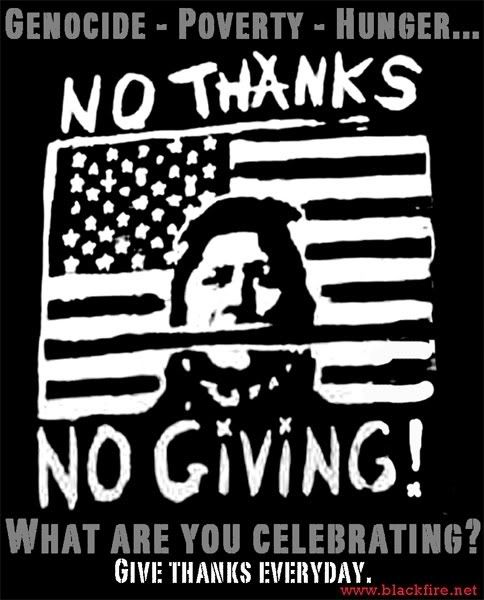
The True Story Of Thanksgiving

Originally written by Richard Greener for The Huffington Post.


Richard Greener

Richard Greener

Posted: November 25, 2010 10:04 AM


The idea of the American Thanksgiving feast is a fairly recent fiction. The idyllic partnership of 17th Century European Pilgrims and New England Indians sharing a celebratory meal appears to be less than 120 years-old. And it was only after the First World War that a version of such a Puritan-Indian partnership took hold in elementary schools across the American landscape. We can thank the invention of textbooks and their mass purchase by public schools for embedding this "Thanksgiving" image in our modern minds. It was, of course, a complete invention, a cleverly created slice of cultural propaganda, just another in a long line of inspired nationalistic myths.
The first Thanksgiving Day did occur in the year 1637, but it was nothing like our Thanksgiving today. On that day the Massachusetts Colony Governor, John Winthrop, proclaimed such a "Thanksgiving" to celebrate the safe return of a band of heavily armed hunters, all colonial volunteers. They had just returned from their journey to what is now Mystic, Connecticut where they massacred 700 Pequot Indians. Seven hundred Indians - men, women and children - all murdered.
Source
This day is still remembered today, 373 years later. No, it's been long forgotten by white people, by European Christians. But it is still fresh in the mind of many Indians. A group calling themselves the United American Indians of New England meet each year at Plymouth Rock on Cole's Hill for what they say is a Day of Mourning. They gather at the feet of a stature of Chief Massasoit of the Wampanoag to remember the long gone Pequot. They do not call it Thanksgiving. There is no football game afterward. 
How then did our modern, festive Thanksgiving come to be? It began with the greatest of misunderstandings, a true clash of cultural values and fundamental principles. What are we thankful for if not - being here, living on this land, surviving and prospering? But in our thankfulness might we have overlooked something? Look what happened to the original residents who lived in the area of New York we have come to call Brooklyn. A group of them called Canarsees obligingly, perhaps even eagerly, accepted various pieces of pretty colored junk from the Dutchman Peter Minuet in 1626. These trinkets have long since been estimated to be worth no more than 60 Dutch guilders at the time - $24 dollars in modern American money. In exchange, the Canarsees "gave" Peter Minuet the island of Manhattan. What did they care? They were living in Brooklyn.
Of course, all things - especially commercial transactions - need to be viewed in perspective. The nearly two-dozen tribes of Native Americans living in the New York area in those days had a distinctly non-European concept of territorial rights. They were strangers to the idea of "real property." It was common for one tribe to grant permission to another to hunt and fish nearby themselves on a regular basis. Fences, real and imagined, were not a part of their culture. Naturally, it was polite to ask before setting up operations too close to where others lived, but refusal in matters of this sort was considered rude. As a sign of gratitude, small trinkets were usually offered by the tribe seeking temporary admission and cheerfully accepted by those already there. It was clearly understood to be a sort of short-term rental arrangement. Sad to say, the unfortunate Canarsees apparently had no idea the Dutch meant to settle in. Worse yet for them, it must have been unthinkable that they would also be unwelcome in Manhattan after their deal. One thing we can be sure of. Their equivalent of today's buyer's remorse brought the Canarsees nothing but grief, humiliation and violence.

Dismantling Thanksgiving Myths: A Native American Story


Originally published by NDN News in November 2008, but the topic at hand is a timeless TRUTH of the history of our country. 

Dismantling Thanksgiving Myths: A Native American Story

Source

by Aisha Ali, D.C. Youth Issues Examiner


In less than two weeks, Thanksgiving will arrive. The need for celebration may not come as easily for those who have lost their homes and have suffered many misfortunes throughout the year. However, one should be thankful for just being alive, shouldn’t they?

Nonetheless, I view Thanksgiving differently from others, even before this current economic crisis. While I always have expressed "thanks" for the many blessings God has bestowed upon me, with underserved communities experiencing destitution, living in substandard housing, being unable to properly care for their children; to afford health care; or to just overall survive, how could I be happy? To know many people would be homeless or starving on Thanksgiving certainly does evoke a "warm, light-hearted feeling".

The lives many Americans have experienced within the past few years, especially within the past year, have been the “ordinary” lives of many individuals for quite some time. Yes, the desolate life of others does intensify my gratefulness; however, as is the case with many middle-class Americans, my family has always been two or three paychecks away from homelessness. Still, this suffering of which I think on Thanksgiving does not discriminate me from others, as I am quite certain other Americans share the same sentiment. My view of Thanksgiving differs given my ethnic background as an individual of both African- and Native American descent. It is for this reason I always have held a jaded view concerning Thanksgiving, knowing its true history— or the true Native American story-- has yet to be published in many American history books.

In my eyes, Thanksgiving has never been about the Pilgrims-- and to many Americans, I question if this is their sole source of celebration, as many people blindly celebrate holidays and have no clue of their history. Although I am sure many people celebrate Thanksgiving as a way to express “thanks,” for me, Thanksgiving serves as another remembrance of how my Native American ancestors were maltreated; annihilated; ousted from their land; and consigned to reservations, eradicating every trace of their pre-existing life.

Thanksgiving rehashes memories of how the hospital staff, in its refusal to treat my great-great grandfather, sent him home to die from pneumonia because he was Native American. Thanksgiving reminds me of how my great-grandmother had “to pass” as a light-skinned black person to avoid being forced on a reservation. When thinking of Thanksgiving, I recall how my Nation, the Cherokees, was forced from its land in Georgia, leaving a “Trail of Tears.” As I sit around with my family and share thoughts while eating on Thanksgiving, I think of how the very ingredients with which my food was prepared, had been once picked by the hands of my Native American ancestors who served as slaves in North Carolina and the Caribbean. Needless to say, I also think of my African ancestors who toiled away in the fields to pick the very foods with which my food was prepared. America, to me, is not the “Land of Pilgrim’s pride," but should be and is to me, the "Land of Native American pride".

The national holiday, “Thanksgiving,” was not initially created in the way most Americans have come to know it.

Friday, August 27, 2010

Micro-loans Available Through Cherokee Nation Program

Cherokee Nation News Release
(918) 453-5378 FAX (918) 458-6181
Cherokee Nation Director of Communications@cherokee.org
© Cherokee Nation - All Rights Reserved


Source
Sometimes a small boost is all that’s needed to get a business underway or to help get credit on the right track. That’s the premise behind some of the small business loan programs available now through the Cherokee Nation.

The tribe’s Small Business Assistance Center, located at 17675 S. Muskogee Ave., in Room 105, is now taking applications for micro-loans to help start up a new small business or to improve an existing one, by adding new materials, work tools or merchandise. Credit-builder loans start with amounts as small as $100 and are geared towards artists and home-based businesses. Other types of micro-loans are available as well.

Small business owners or would-be entrepreneurs can get the ball rolling by meeting with one of the SBAC’s business coaches. The borrower must work with the coach to develop a business plan and will be required to attend a business planning workshop before the loan is submitted for approval.

Interested parties may also simply attend an informational workshop hosted by the SBAC to see whether a micro-loan is right for their business. Dates and locations for upcoming workshops include:

     Collinsville— Monday, Aug. 30, from 11 a.m. to 1 p.m. at 1323 W. Broadway St. 

     Kansas, Okla.—Wednesday, Sept. 1, from 6 p.m. to 8 p.m. at the Northeast Technology    Center, 450 N. Highway 59 

     Bartlesville— Friday, Sept. 3 from 1 p.m. to 3 p.m. at 1003 S. Virginia Ave.

To participate in the micro-loan programs, applicants must be a citizen of a federally recognized tribe and must live within the Cherokee Nation’s 14-county jurisdictional area. Other eligibility criteria may apply, depending on the specific program.

For more information please contact Veronica Hix at (918) 207-3955 or e-mail 
veronica-hix@cherokee.org.


Saturday, July 3, 2010

American Anthem in the language of its original Mother


Thursday, November 26, 2009

Gratitude


I am THANKFUL for: 


My Momma, who is the greatest love in my life. Seriously, I think Unehana/God was really being awesome the day S/He assigned mommas to kiddies; S/He gave me to her ;o) Can there ever be a love so visceral and so selfless than the one a mother has for her child? She may not agree with how I'm putting graduate school on hold to move to Turkey, but she understands that I need to find myself first. When all's been said and done, my momma is one of my best friends and I love her more than life itself. 
JC and RS, my soul mates. Calling them 'best friends' or 'sisters' seems so shallow, because they're so much more that that. They're the type of friends you can call at 3 A.M. or 3 P.M. and would go to bat for you when someone says an unkind word to/at you. They are fellow humanitarians--kind, generous, loving, strong--and through their deeds, renews my faith in the goodness of man.
BG, my best guy friend / Irish brotha ;o) He's the only man I would go into a fight for, if ever some woman broke his heart. He's a 3rd degree black belt in Tae Kwon Do and breaks bricks for fun, but he's also the gentlest man I know. With him, I feel 100% safe, because I know nothing could ever hurt me while he's around.  
My Native Ancestors, who taught me that we are not owners of the land, but rather, its stewards. I am grateful that even though policies have been enacted to rid AmerIndians and Hawaiians of our lands, language, cultures, religions, traditions, and lives, WE ARE STILL HERE. Man-made policies and tyrants may attempt to take away our freedom, but never take away our dignity and humanity. Nunna daul isunyi--The Trail Where We Cried--is THE PATH WHERE WE PERSEVERE. 
Being an American. Although it has its inequities and  I do not completely agree with my country's policies on war, immigration, and the current healthcare system, I am blessed to be a citizen of a country that is truly a global salad. The U.S.A. is not a Melting Pot, because that would imply that all the ingredients have to meld and lose their individual flavours in order to become a dish with one distinct taste. No, my country is a salad that allows individuals to retain their individual flavours and colours, while being a part of a unified dish. 
Having graduated from an awesome university (and currently 'taking some time off from graduate school'). Education is a luxury that some--if not most--people could only dream about. 
The fact that I am moving to Istanbul in a month! After a major postponement for a pesky health issue, it's finally happening ;o) Maybe I'll love it there or maybe I'll hate it, but this is an adventure I cannot wait to take. Life is an exploration, evet? 

The fact that I am NOT a Turkey 
 BEING ALIVE 

Tuesday, November 24, 2009

1 in 3 is More than a Statistic to AmerIndian Women


Leslie Ironroad was 20 years old when she moved from one side of the Standing Rock Sioux Reservation in the Dakotas to the other — the town of McLaughlin, S.D., home to one gas station, one diner and her friend, Rhea Archambault. She roomed in Archambault's spare bedroom.
"I make star quilts, so she was helping me make patterns," Archambault said recently, sitting at her dining room table. "She was just a nice little girl."
One night four years ago, Ironroad left the house to go to a party a few miles away. Early the next morning, she called Archambault's brother in tears asking to be picked up.
"She said, 'Can [you] go get Rhea to come get me 'cause these guys are going to fight me,'" Archambault said. "And so he said, 'Well where you at?' And she was just crying and hangs up."
Leslie never made it home.
When Archambault found her friend in a Bismarck, N.D. hospital, she was black and blue.
"'I said, 'Leslie, what happened?.' She said, 'Rhea, is that you? Turn the lights on, I can't see.' But the lights in the room were on. She said, 'Rhea, I was raped,' and she was just squeezing my hand," Archambault recalled.
Archambault called the Bureau of Indian Affairs police, a small department in charge of all law enforcement on the reservation. A few days later an officer arrived in the hospital room, and Leslie scratched out a statement on a tablet laid across her stomach.
Ironroad told the officer how she was raped and said that the men locked her in a bathroom, where she swallowed diabetes pills she found in the cabinet, hoping that if she was unconscious the men would leave her alone. The next morning, someone found her on the bathroom floor and called an ambulance.
A week later, Ironroad was dead — and so was the investigation. None of the authorities who could have investigated what happened to Leslie Ironroad did — not the Bureau of Indian Affairs, nor the FBI, nor anybody else.
People who know the men who likely attacked her say they were never even questioned.
Archambault couldn't believe nothing came of Ironroad's report.
"She named all the people that were there, the ones that were hitting her, the ones that were fighting her, she named everybody — what more else?" Archambault asked.
Unreported, Uninvestigated and Unprosecuted


Friday, November 20, 2009

The Bloodline the Tsalagi Will NEVER Vanish


A video I made as an undergrad for a class on protest
literature.

Tuesday, November 17, 2009

The U.S.A is Home to Third World Conditions


The American economic system is a dichotomy. As others live in $75 million dollar McMansions , some of the original inhabitants of this country live in squalor that most equate with the other side of the world.
Let’s talk statistics for a moment, shall we?:
Name: Pine Ridge Indian Rez  (~1.7 million acres)
Where: South Dakota
Inhabitants: Oglala Sioux (~30,000)
Average Annual Family Income: $3,700.00
Average Unemployment Rate: 80%


$3,700 annually. That is well below the Federal poverty level, set at ~$15,000. And yes, this is in the United States of America, the Leader of the Free World. How can we, as a nation, justify the spending of millions of dollars on a presidential campaign when its people are living in abject poverty? How dare a president choose to spend billions on a war abroad when his citizens are fighting a losing war on poverty? How dare a president ask his constituents to “keep the faith” on the War on Terror when they are terrorized by hunger and unemployment? How dare a president ask a nation to “stay the course” when harsh winters force the elderly to choose between warmth or medication?

We must never permit the voice of humanity
within us to be silenced. It is Man's sympathy with all creatures that first makes him a Man.

--Albert Schweitzer

Everything can be taken from a man or a woman but one thing: the last of human freedoms to choose one's attitude in any given set of circumstances, to choose one's own way.


--Viktor E. Frankl