Showing posts with label genocide with a side of pumpkin pie. Show all posts

Thursday, November 25, 2010

The True Story Of Thanksgiving

Originally written by Richard Greener for The Huffington Post.


Richard Greener

Richard Greener

Posted: November 25, 2010 10:04 AM


The idea of the American Thanksgiving feast is a fairly recent fiction. The idyllic partnership of 17th Century European Pilgrims and New England Indians sharing a celebratory meal appears to be less than 120 years-old. And it was only after the First World War that a version of such a Puritan-Indian partnership took hold in elementary schools across the American landscape. We can thank the invention of textbooks and their mass purchase by public schools for embedding this "Thanksgiving" image in our modern minds. It was, of course, a complete invention, a cleverly created slice of cultural propaganda, just another in a long line of inspired nationalistic myths.
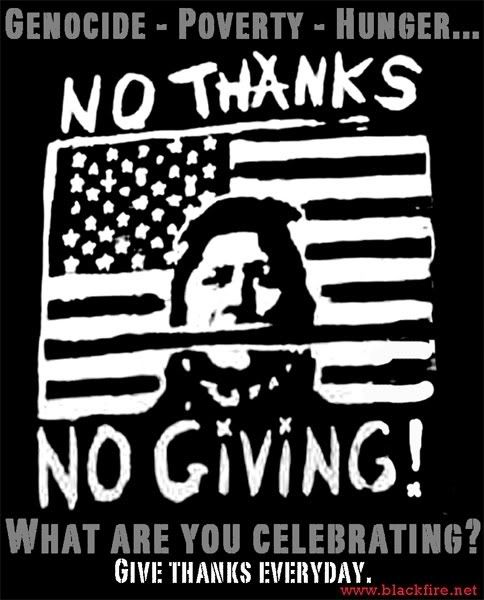
The first Thanksgiving Day did occur in the year 1637, but it was nothing like our Thanksgiving today. On that day the Massachusetts Colony Governor, John Winthrop, proclaimed such a "Thanksgiving" to celebrate the safe return of a band of heavily armed hunters, all colonial volunteers. They had just returned from their journey to what is now Mystic, Connecticut where they massacred 700 Pequot Indians. Seven hundred Indians - men, women and children - all murdered.
Source
This day is still remembered today, 373 years later. No, it's been long forgotten by white people, by European Christians. But it is still fresh in the mind of many Indians. A group calling themselves the United American Indians of New England meet each year at Plymouth Rock on Cole's Hill for what they say is a Day of Mourning. They gather at the feet of a stature of Chief Massasoit of the Wampanoag to remember the long gone Pequot. They do not call it Thanksgiving. There is no football game afterward. 
How then did our modern, festive Thanksgiving come to be? It began with the greatest of misunderstandings, a true clash of cultural values and fundamental principles. What are we thankful for if not - being here, living on this land, surviving and prospering? But in our thankfulness might we have overlooked something? Look what happened to the original residents who lived in the area of New York we have come to call Brooklyn. A group of them called Canarsees obligingly, perhaps even eagerly, accepted various pieces of pretty colored junk from the Dutchman Peter Minuet in 1626. These trinkets have long since been estimated to be worth no more than 60 Dutch guilders at the time - $24 dollars in modern American money. In exchange, the Canarsees "gave" Peter Minuet the island of Manhattan. What did they care? They were living in Brooklyn.
Of course, all things - especially commercial transactions - need to be viewed in perspective. The nearly two-dozen tribes of Native Americans living in the New York area in those days had a distinctly non-European concept of territorial rights. They were strangers to the idea of "real property." It was common for one tribe to grant permission to another to hunt and fish nearby themselves on a regular basis. Fences, real and imagined, were not a part of their culture. Naturally, it was polite to ask before setting up operations too close to where others lived, but refusal in matters of this sort was considered rude. As a sign of gratitude, small trinkets were usually offered by the tribe seeking temporary admission and cheerfully accepted by those already there. It was clearly understood to be a sort of short-term rental arrangement. Sad to say, the unfortunate Canarsees apparently had no idea the Dutch meant to settle in. Worse yet for them, it must have been unthinkable that they would also be unwelcome in Manhattan after their deal. One thing we can be sure of. Their equivalent of today's buyer's remorse brought the Canarsees nothing but grief, humiliation and violence.

Dismantling Thanksgiving Myths: A Native American Story


Originally published by NDN News in November 2008, but the topic at hand is a timeless TRUTH of the history of our country. 

Dismantling Thanksgiving Myths: A Native American Story

Source

by Aisha Ali, D.C. Youth Issues Examiner


In less than two weeks, Thanksgiving will arrive. The need for celebration may not come as easily for those who have lost their homes and have suffered many misfortunes throughout the year. However, one should be thankful for just being alive, shouldn’t they?

Nonetheless, I view Thanksgiving differently from others, even before this current economic crisis. While I always have expressed "thanks" for the many blessings God has bestowed upon me, with underserved communities experiencing destitution, living in substandard housing, being unable to properly care for their children; to afford health care; or to just overall survive, how could I be happy? To know many people would be homeless or starving on Thanksgiving certainly does evoke a "warm, light-hearted feeling".

The lives many Americans have experienced within the past few years, especially within the past year, have been the “ordinary” lives of many individuals for quite some time. Yes, the desolate life of others does intensify my gratefulness; however, as is the case with many middle-class Americans, my family has always been two or three paychecks away from homelessness. Still, this suffering of which I think on Thanksgiving does not discriminate me from others, as I am quite certain other Americans share the same sentiment. My view of Thanksgiving differs given my ethnic background as an individual of both African- and Native American descent. It is for this reason I always have held a jaded view concerning Thanksgiving, knowing its true history— or the true Native American story-- has yet to be published in many American history books.

In my eyes, Thanksgiving has never been about the Pilgrims-- and to many Americans, I question if this is their sole source of celebration, as many people blindly celebrate holidays and have no clue of their history. Although I am sure many people celebrate Thanksgiving as a way to express “thanks,” for me, Thanksgiving serves as another remembrance of how my Native American ancestors were maltreated; annihilated; ousted from their land; and consigned to reservations, eradicating every trace of their pre-existing life.

Thanksgiving rehashes memories of how the hospital staff, in its refusal to treat my great-great grandfather, sent him home to die from pneumonia because he was Native American. Thanksgiving reminds me of how my great-grandmother had “to pass” as a light-skinned black person to avoid being forced on a reservation. When thinking of Thanksgiving, I recall how my Nation, the Cherokees, was forced from its land in Georgia, leaving a “Trail of Tears.” As I sit around with my family and share thoughts while eating on Thanksgiving, I think of how the very ingredients with which my food was prepared, had been once picked by the hands of my Native American ancestors who served as slaves in North Carolina and the Caribbean. Needless to say, I also think of my African ancestors who toiled away in the fields to pick the very foods with which my food was prepared. America, to me, is not the “Land of Pilgrim’s pride," but should be and is to me, the "Land of Native American pride".

The national holiday, “Thanksgiving,” was not initially created in the way most Americans have come to know it.

We must never permit the voice of humanity
within us to be silenced. It is Man's sympathy with all creatures that first makes him a Man.

--Albert Schweitzer

Everything can be taken from a man or a woman but one thing: the last of human freedoms to choose one's attitude in any given set of circumstances, to choose one's own way.


--Viktor E. Frankl